According to OpenAI, more than 100,000 advertisers have launched ads in ChatGPT. Reportedly, the advertising business reached an annual revenue run rate of $1 billion less than 200 days after launch. However, by November 2026, early campaign results remained mixed: some advertisers failed to recoup their spending, while others achieved results on par with or better than Google Ads.
For companies, the key question is not just the cost per click or lead, but whether those leads turn into suitable clients. Comparisons between the new channel and long-optimized search campaigns should also account for differences in audience intent and sales cycles.
What the first tests showed
Business Insider cited Adthena data on 30 major brands that shared results for the period from July to September 2026. Adthena estimated that 52% struggled to recoup their spending, 26% achieved results on par with or better than Google Ads, and 22% reported mixed results.
However, Adthena disclosed few details about how the brands measured returns or which Google campaigns they used for comparison. An assessment based on cost per lead may differ from one based on closed sales, and a sample of 30 companies cannot reliably predict an individual advertiser’s results.
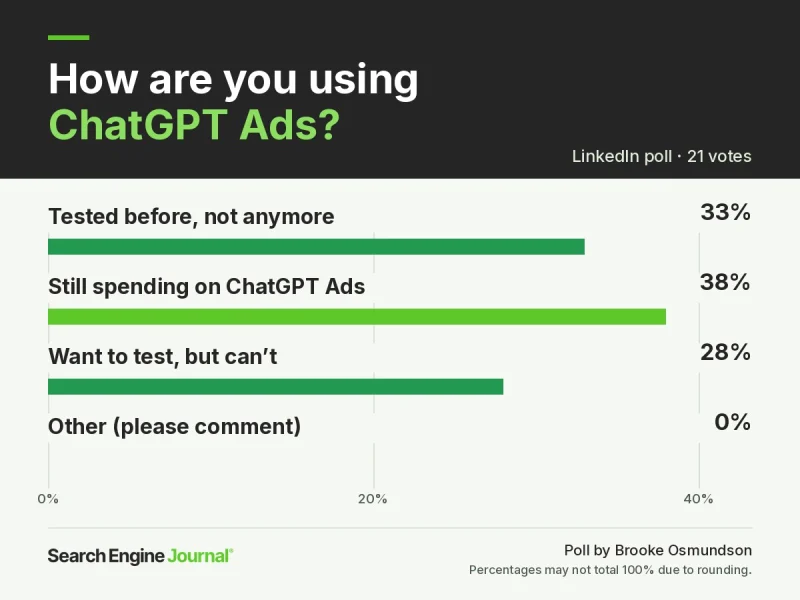
The author of the original article also conducted a small LinkedIn poll: of 21 respondents, eight were still spending money on ChatGPT Ads, seven had tested the ads and stopped, and six wanted to run a test but could not. The poll reflects the participants’ experiences, not the market as a whole.
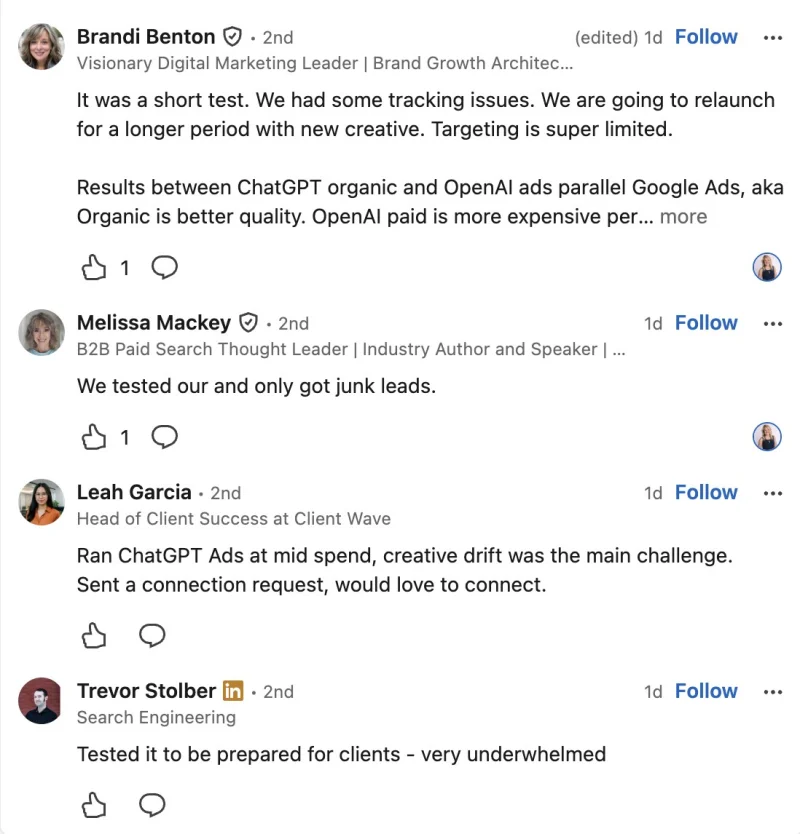
In the comments, Melissa Mackey described the leads she received as low-quality, Trevor Stolber was disappointed with his test, and Leah Garcia identified ad creatives deviating from the intended concept as the main issue. Brandy Benton encountered tracking difficulties and described the targeting as very limited. She said the quality of the clients acquired was comparable to Google Ads, but the cost was higher and the volume lower. Organic traffic from ChatGPT generated higher-quality leads; Benton planned to repeat the test with new creatives and give it more time.
Why some companies kept small budgets
James Hamilton, co-founder of the agency oakpool, said most clients in the pilot program continued advertising. Since spring 2026, the agency had run campaigns for companies in boutique hotels, B2B services and entertainment. According to Hamilton, return on ad spend was lower than on Google, but sufficient to justify keeping a small budget.
Hamilton noted that OpenAI’s conversion pixel worked well in hotel campaigns, although he would have liked more detail. He did not disclose spending or returns by industry, so his assessment cannot establish how results would change with a larger budget.
Clients asked Hamilton more often about appearing in ChatGPT’s organic responses than about buying ads. He suggested that this balance could change as the product develops. Another agency representative said that strong organic results prompted some clients to try paid placements, but some campaigns then began generating inquiries for work the companies could not take on.
Cost per lead and the actual value of an inquiry
An agency representative who requested anonymity said the company spent around $15,000 on its own ChatGPT advertising in the first month. The campaigns initially performed well, then results deteriorated. The agency subsequently cut spending to about $800 a month and began treating it primarily as a brand awareness expense.
According to the representative, about half of the agency’s clients who tried ChatGPT Ads stopped their campaigns and moved their budgets back to Google. The reasons included problems tracking conversions and a lack of information about where and why ads were shown.
One client, a bankruptcy attorney, received up to 20 conversions a month at a low cost per lead. But over two months, the campaign did not bring in a single paying client: the inquiries concerned the attorney’s area of practice but did not match the types of cases he wanted to take.
OpenAI’s pixel and Conversions API help link a form submission to an ad, but they do not explain lead quality on their own. In such a situation, it is worth reviewing records of initial inquiries and checking whether the ad or landing page created a misleading impression of the service. If the offer is clearly stated and unsuitable inquiries continue, information about the context in which ads appeared would be useful for further assessment.
Problems launching campaigns and spending the budget
Gil Gildner said ad approvals took weeks and sometimes months. To get the campaigns running, his team broadened their settings. In the first week, the average cost per click was below one dollar, but preliminary observations suggested that impressions had shifted toward lower-income markets that the client did not intend to prioritize.
The client approved a substantial test budget, but Gildner doubted that the team would be able to spend it as planned. The average cost per click showed the price of available traffic but did not provide a clear picture of costs in the markets the client actually wanted to test.
Why comparisons with Google Search require caution
A working study by Maximilian Kaiser and Christian Schulze examined 102 advertiser websites with full sales tracking. In the US, visits from ChatGPT Ads generated $0.89 in revenue per session, compared with $2.45 for Google search ads. These figures do not account for what advertisers paid for the visits.
OpenAI’s Evernote case study tracked users who started a free trial. In the ChatGPT Ads campaigns presented, the rate at which trial users converted to paid subscriptions was approximately 10–20% higher than Evernote’s historical average for paid acquisition. However, the case study does not disclose the cost of acquiring subscribers or answer how many would have subscribed without advertising.
A CPA benchmark from Google Search can be misleading if a search campaign gets conversions primarily from people who are already searching for the brand or checking prices. In ChatGPT, a user may discover a product several weeks before requesting a demo, so an assessment based only on the first week’s results will miss that part of the buyer journey.
A B2B team can benefit from tagging paid and organic visits from ChatGPT separately, then storing the source in its CRM. If tracking can link visits, the team can see whether a user later returned through Google, submitted an inquiry and became a promising sales opportunity. To determine whether the ads generated opportunities that would not otherwise have arisen, the team would need to compare results with campaigns running and paused.
How conversation context affects advertising
According to OpenAI’s technical description, the ad system uses previous messages to understand the user’s task, select relevant ads and weigh relevance against bids. Winning the auction does not guarantee that an ad will be shown.
A B2B buyer might first use ChatGPT to determine which features their team needs, then search for vendor pricing on Google. Research on the overlap between the two platforms’ audiences makes such a journey plausible, but does not prove that a particular ad helped put a vendor on the buyer’s shortlist.
OpenAI says advertisers cannot see users’ conversations. Even aggregated information about the types of conversations in which ads appeared could help assess a campaign, if it can be provided without compromising privacy. For example, a comparison page may suit an audience still deciding which features it needs; for those already evaluating vendors, information about integrations and pricing may matter more.
What to base the next budget on
By November 2026, ChatGPT Ads had been operating for less than a year. Some advertisers were already generating enough business to continue advertising, but there is still little evidence that these results will hold across more companies or at higher budgets.
In the future, more detailed impression reports and improved conversion tracking could help advertisers revisit paused tests. Until then, results that can be traced to a sale or qualified opportunity provide a more reliable basis for the next budget than CPA from an account optimized over many years. If a company understands why paid leads are unsuitable, it is especially difficult to justify extending a campaign without changes.
Discussion
Sign in or create an account, to join the discussion.