AI agents are becoming an additional audience for online stores: they not only help users choose products but can also make purchases on their behalf. According to the author of the original article, in 2026 store owners will need to accommodate the needs of both people and agents.
For SEO, this means working not only with conventional web pages but also with product feeds, structured data, and ways to connect stores to AI platforms. Two protocols relevant to this task are the Agentic Commerce Protocol (ACP) and the Universal Commerce Protocol (UCP).
What is agentic commerce?
Agentic commerce means that an AI agent makes a purchase on a user's behalf and with their approval. The person interacts with a platform powered by a language model, and the agent can find a product on a website and place an order.
The agent therefore participates not only in finding information and making recommendations but also in the transaction itself. This differs from a scenario in which a language model merely suggests options or helps verify a decision already made.
ACP: How agents, merchants, and payment providers interact
On September 29, 2025, OpenAI and Stripe announced a partnership and introduced ACP, an open standard that defines how AI agents, merchants, and payment providers interact during purchases.
On the day of the announcement, OpenAI named Shopify and Etsy among the platforms that could immediately take advantage of agentic commerce. Other companies, including Walmart and Instacart, later began using the protocol.
According to the original article, Shopify has enabled ACP for more than a million merchants since the announcement. WooCommerce later announced its participation in the launch of Stripe Agentic Commerce Suite, which is intended to let more stores sell products through various AI platforms.
UCP: A broader customer journey
By the time the original article was published on January 12, 2026, Google had introduced the Universal Commerce Protocol. Its purpose is to give different AI interfaces, such as AI Mode in Search and Gemini, a common language for discovering merchants, understanding their capabilities, and organizing the customer journey, from product discovery to order management and post-purchase interactions.
UCP also provides for integration with existing standards and technologies, including APIs, Agent2Agent (A2A), and Model Context Protocol (MCP). The original article also notes the use of Google Pay to simplify payments.
ACP focuses on agentic purchases in ChatGPT and other agents that support the protocol. According to the source, it covers product feeds, checkout, fulfillment, and delegated payments. UCP is designed as shared infrastructure for interactions between merchants and different agents and interfaces; it covers product discovery, checkout, discounts, fulfillment, order management, and payments.
The author suggests considering both protocols to work with different platforms and ecosystems. The author also suggests that the context available to Google across its services could eventually make such purchases more convenient for users. This is a prediction, not a confirmed result of UCP implementation.
What agentic commerce changes for SEO
Optimizing for people remains necessary, but agents are now an additional audience. The author notes that agents can obtain information through APIs, product feeds, and structured data, making the quality of these sources part of the SEO task.
The author uses the term ACO—Agentic Commerce Optimization—as a working label for this effort, but emphasizes that it is still SEO. The author identifies several areas:
Crawlability. Links, user journeys, and site architecture all need attention: the article notes that agents can also follow links and take a site's structure into account.
Content format. Information should be concise and consistent across the site while containing enough detail to provide value on its own.
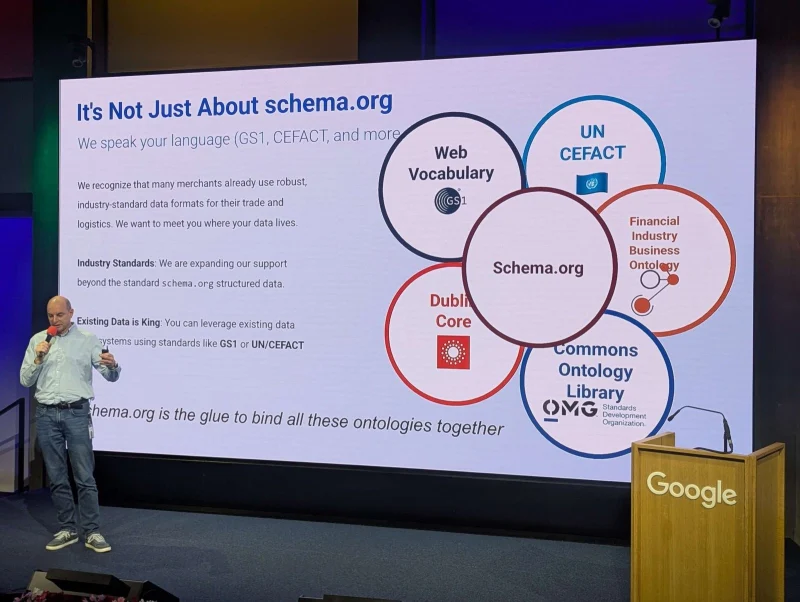
Structured data. Existing open standards help convey product information in a machine-readable format.
Brand authority and perception. Detailed product listings are not enough: third-party assessments of a brand may also matter to agents and users. The author suggests that external sources will become more prominent in supporting agents' responses.
Connecting ACP links a store to platforms where agents operate, and CMS platforms can simplify the integration. However, enabling the protocol does not in itself mean that the store's data and content are already optimized.
The role of Schema.org and product data
At Google Search Central Live in Zurich in December 2025, Pascal Flury spoke in detail about structured data for shopping. The original article describes Schema.org as a connecting element, while other industry standards, such as GS1, can add more detailed product information.
Areas requiring attention include product markup, prices, availability, reviews, answers to frequently asked questions, delivery options, other logistics information, and loyalty programs. The author warns that missing or incorrect data can make it harder for agents to discover products.
How to check how agents present your products
You can start checking before connecting ACP. The author suggests asking AI platforms questions about products in your category and seeing whether your brand appears in the answers, how its products and related offers are described, what information comes from your own and third-party sources, and what expected information is missing.
After connecting the protocol, you can repeat the queries and compare the results. This approach lets you separately assess the initial visibility of your products and any potential changes after integration.
Where to start with ACP and UCP implementation
At the time the original article was published in January 2026, WooCommerce and Wix users were invited to join the Stripe Agentic Commerce Suite waitlist, while Shopify users were invited to join the platform's own waitlist. The author expected the full rollout to accelerate in the first quarter of 2026; this was a prediction at the time.
For stores that need direct ACP integration into their CMS, early implementation may require more resources. The author suggests that it could also provide an opportunity to appear in agentic search sooner, while other stores wait for ready-made solutions from their CMS providers, but does not consider this advantage guaranteed.
As for UCP, the author noted that the protocol was new as of the publication date and recommended studying its documentation and GitHub repository, as well as experimenting with it where possible.
Source: https://www.searchenginejournal.com/agentic-commerce-what-seos-need-to-consider-acp-ucp/563503/
Discussion
Sign in or create an account, to join the discussion.