In early 2026, Growth Memo author Kevin Indig described an approach to optimizing websites for search powered by large language models. He suggests viewing visibility as a sequence of three stages: the system finds a page, the model selects it for citation, and the user decides whether to trust the source and act on the answer.
Indig notes that many of his recommendations overlap with traditional SEO and that his list is not intended to be exhaustive. He does not include disputed factors such as schema and llms.txt among the main areas of optimization.
The broader context remains uncertain. In late 2025, Google released Gemini 3, and Sam Altman declared a Code Red at OpenAI. Indig also points to questions surrounding the financing of interconnected OpenAI investments and estimates that referrals from ChatGPT—the largest source of referral traffic among LLMs—amount to no more than 4% of existing organic traffic. At the same time, he says, the value of being mentioned in an AI answer remains unknown.
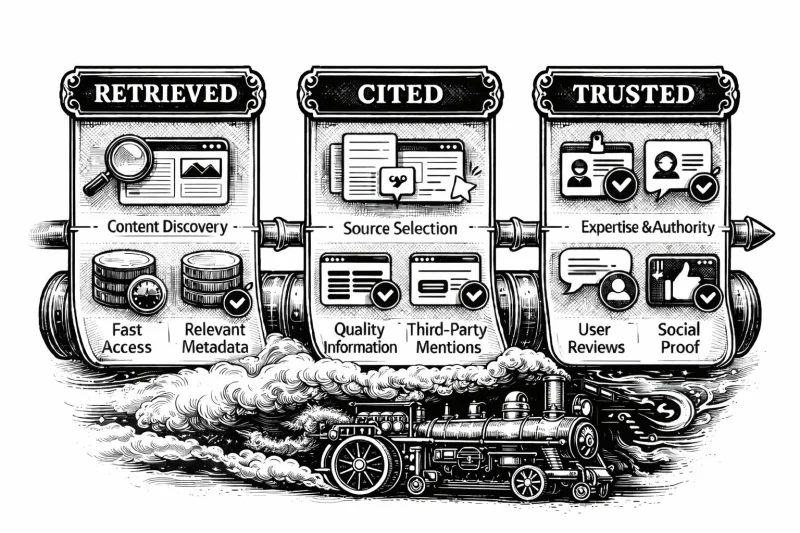
How to Get into the Source Set
Before a model can use a page to formulate an answer, the page must be available for crawling, indexing, and rapid retrieval during a search. Indig identifies several factors that affect inclusion in the candidate set.
Brand Associations and Selection Frequency
The author describes primary bias as the associations between a brand and its attributes that a model has formed before consulting search results. For example, a model may associate a brand with affordability, durability, or speed. Selection frequency shows how often a model chooses a site's content from the set of retrieved candidates.
According to Indig, associations formed during training can affect the likelihood of citation even after a page has been retrieved. He advises finding out which attributes a model associates with a brand and how confidently it recognizes the brand as an entity, then consistently reinforcing the desired associations on and off the site.
Server Response Speed
Time to first byte, or TTFB, measures the interval between a request and receipt of the first byte of the server response. Although source retrieval relies primarily on an index, the author considers speed important for rendering, agentic scenarios, retrieving fresh data, and processing multiple derivative queries.
Indig recommends aiming for a server response time under 200 ms. He also cites an estimate that sites loading in under a second receive three times as many Googlebot requests as sites loading in over three seconds. He claims that delays can prevent a page from being retrieved within the allotted time, while consistently slow performance can lead to a reduced crawl rate. For AI crawlers, including GPTBot and Google-Extended, he considers time limits even stricter than in conventional search.
Metadata and Product Feeds
Indig advises including target concepts in both page titles and meta descriptions so they match the wording of user queries. As he describes it, models use the title to assess the topic, the description as a summary of the document, and the URL as an additional cue about relevance and reliability. He also recommends clear page URLs and suggests that including the current year can signal freshness.
For e-commerce, a separate channel is structured product catalogs containing price, availability, and product attributes. The article recommends submitting merchant-managed feeds to ChatGPT's merchant program in JSON, CSV, TSV, or XML format, including names, prices, images, reviews, availability, and specifications. For agentic shopping, the author suggests using the Agentic Commerce Protocol (ACP). These recommendations reflect the platform capabilities described as of early 2026.
What Helps Earn Citations
Being retrieved does not guarantee a link in the answer. Indig cites the 2025 study “The Attribution Crisis in LLM Search Results” by Strauss and colleagues: according to the figures reported, 24% of ChatGPT answers using the 4o model were generated without explicitly retrieving web content, Gemini provided no clickable link in 92% of answers, and Perplexity visited around ten relevant pages per query but cited only three or four.
The author notes that a model can cite only sources included in its context window. Information absorbed during pre-training often appears without attribution; retrieving a page during search adds a URL and makes attribution possible.
Structure and Answers to Questions
Indig recommends using semantic HTML markup with a clear heading hierarchy, tables for comparisons, and lists for enumerations. In his view, a clear structure makes it easier to extract individual passages, while a high density of facts and concepts increases the likelihood that content will be used in an answer. He also cites an estimate that prompts to models are, on average, five times longer than keyword queries, and suggests answering multi-part questions rather than focusing solely on individual keyword phrases.
The author advises building Q&A sections around customers' actual wording from support requests, sales conversations, and forums. In his view, this format better matches conversational queries. To track whether FAQs are up to date, he suggests using the schema fields lastReviewed or DateModified, although he does not generally include schema among the main factors because its impact is disputed.
Content Freshness
Indig recommends keeping content updated within the past three months and associates freshness not only with the modification date but also with substantive edits. He cites data indicating that more than 70% of pages cited by ChatGPT had been updated within 12 months, while content updated in the previous three months performed better across different query types. This observation, cited in the article as of early 2026, does not by itself establish a causal link between update dates and citations.
Mentions on Third-Party Sites
The author uses the term webutation to encompass brand mentions, reviews, and links on external sites, including publications, news articles, and review platforms. In his assessment, external validation becomes especially important as a user approaches a purchase, because it allows them to check a company's claims and associate the brand with recognized players in its category.
Indig cites an estimate that 85% of brand mentions in AI search for high-purchase-intent queries come from third-party sources. He recommends seeking contextual links from authoritative sites and maintaining complete profiles on relevant review platforms.
Traditional Search Rankings
Since many models use search engines to retrieve content, traditional rankings remain a useful benchmark. The author advises working not only on core queries but also on a wide range of long-tail and question-based queries around key topics.
The article cites a correlation of approximately 0.65 between pages ranking in the top ten and mentions in LLM answers, as well as an estimate that 76% of citations in AI Overviews come from top-10 pages. Indig notes that the relationship varies by system: the overlap is high for AI Overviews and low for ChatGPT. Correlation does not mean that a ranking itself guarantees a citation.
How to Earn User Trust
Even a link in an answer does not mean a person will visit the site or take action. Indig compares building trust to optimizing click-through rates in traditional search, but considers it a longer process that is harder to measure: the user receives a synthesized answer and may want to verify its claims.
Demonstrated Expertise
The author recommends prominently displaying author information, professional certifications, and verifiable evidence: client logos, case study metrics, independent test results, and awards. In his view, promotional claims should be backed by facts so visitors can assess the source's reliability.
Community Presence
Reviews and discussions on Reddit, YouTube, and forums help users compare AI answers with other people's experiences. Indig cites data indicating that when AI Overviews appeared, the share of clicks going to Reddit and YouTube rose from 18% to 30%. He also claims that these platforms consistently rank among the three most-cited domains across different LLMs, and advises cultivating a positive presence in relevant communities.
From a List of Results to a Synthesized Answer
Indig views AI search as a shift from choosing among ranked pages to receiving an answer that combines multiple sources. In his model, retrieval windows, source selection frequency, and external validation take on particular importance alongside familiar SEO tasks.
The author's conclusion is not that traditional search should be abandoned: he considers SEO the foundation of visibility, but suggests paying more attention to conversational phrasing, independent mentions, and content structure. Indig expects systematic optimization to give brands an advantage as traffic from LLMs grows and considers the shift to synthesized answers irreversible. This is his prediction, while the practical value of an individual mention in an AI answer, by his own admission, has yet to be determined.
Source: https://www.searchenginejournal.com/state-of-ai-search-optimization-2026/564367/
Discussion
Sign in or create an account, to join the discussion.