According to HubSpot Chief Marketing Officer Kipp Bodnar, the company lost around 80% of its blog’s organic traffic as AI became more widespread, yet its revenue grew by nearly 20%. In an interview with Greg Jarboe for Search Engine Journal, he attributed this in part to the development of channels beyond search.
HubSpot launched a podcast network and acquired a newsletter in 2021, created a creator program in 2022, and launched a YouTube network in 2023. According to Bodnar, the new channels generate around 90% of content leads, while the blog accounts for roughly 10%.
The author of the original article sees podcasts as a way to guide B2B buyers through four stages of engagement: getting them to notice a company, hear from it, trust it, and encounter its name among recommendations. He draws on the experience of his agency, which has produced more than 300 B2B podcasts and arranged more than 2,500 guest appearances since 2019. All the figures he cites from his own experience come from that work.
Why losing search clicks does not always mean losing buyers
According to Bodnar, much of HubSpot’s lost traffic was never likely to generate revenue in the first place. Posts about famous quotes and emojis, for example, attracted millions of visitors, but few intended to buy software. When AI overviews began answering these queries directly in search results, visits declined.
Declining click-through rates affect other sites too. According to Ahrefs, pages in the top position lose 58% of clicks when an AI Overview appears; its April 2025 study put the figure at 34.5%. A Pew Research study found that users clicked on a traditional search result 8% of the time when an AI summary was present, compared with 15% when it was absent.
For B2B, however, trust matters as well as traffic volume. In a 2026 Reddit and SurveyMonkey study, 73% of B2B decision-makers trusted recommendations from peers, compared with 55% who trusted vendor websites. According to Gartner, 61% of B2B buyers prefer to complete the buying process without speaking to a sales representative. The author of the original article suggests that a conversation between practitioners on a podcast is one way to introduce such buyers to a company without a direct advertising pitch.
How to get buyers to notice a podcast
The author has observed that many B2B shows launch without an existing audience: an executive hosts the episodes, but downloads remain low after a few installments, and the project is discontinued. In his view, the problem is not the format itself but the lack of a plan to attract initial listeners.
Two pre-launch steps helped drive growth in his agency’s projects. The prospective host appeared as a guest on podcasts that the target audience already listened to, and the guest list included people with audiences of their own who were willing to share the episode featuring them.
According to the author, HubSpot followed a similar principle on a larger scale: its podcast network and creator program were established years before search traffic fell. Bodnar himself noted that no answer engine optimization tactic could have made up for an 80% traffic loss.
How to capture attention that cold outreach cannot
In Instantly’s 2026 report, the average reply rate for cold emails sent through its platform was 3.43%, while the top 10% of senders exceeded 10%. Instantly sells outbound communication software, so these figures should be treated as data from the platform provider.
Podcasts work differently: listeners choose to play an episode and may spend 20–40 minutes with a guest. A host the audience already trusts introduces the guest at the start of the conversation. The author has observed that potential customers sometimes contact his clients weeks after an appearance and refer to a specific episode.
There is an audience for the format: according to Edison Research’s Infinite Dial 2026, 58% of US residents aged 12 and older listened to podcasts at least once a month. But that does not guarantee demand for an individual corporate show—it still needs a clear reason for its target buyer to listen.
How interviews with buyers help build trust
The author suggests inviting not only well-known experts, partners, or existing customers onto a podcast, but also people from companies the business would like to sell to. Such a conversation can be the start of a relationship rather than simply a way to create content.
As an example, he cites a client of his agency that provides risk management software. The company launched a weekly show in September 2025, with its CEO interviewing security and risk management leaders from target companies. According to the client’s public case study, after approximately 12 months, around 20% of guests had become paying customers. The company also reported a 3.5x return from closed deals in the first six months, as well as additional opportunities in the pipeline. Some listeners who did not participate in the recordings also became customers and referred to specific episodes when they reached out.
The author attributes the result to three factors: the executive participated in recordings regularly, the format allowed the conversation to continue without an immediate sales pitch, and the sales team followed up within a few days of the interview. This is an example involving one agency client, not a guarantee of a similar conversion rate for other companies.
How to use transcripts and guest appearances for AI search
According to Bodnar, AI answer systems draw on more than just a company’s website: they also use third-party sources, including Reddit, LinkedIn, YouTube, and review sites. He also noted that queries can be 40 to 100 words long, so content needs to answer the buyer’s full question in clear language. In response, HubSpot began creating more specific content focused on real buyer situations instead of broad, all-purpose guides.
Podcasts can provide material for this work. A guest appearance is published on someone else’s platform and may be accompanied by a mention, a link in the description, and a transcript. A company’s own show, meanwhile, can capture how a buyer describes a problem in their own words.
The author also describes an experiment of his own: beginning June 1, 2026, his company published a page on its website every day based on episode transcripts and case studies. By October, the daily number of citations in AI answers had risen from around 40–80, where it had held since November 2025, to 250–350. The number of pages cited increased from approximately 15 to 60.
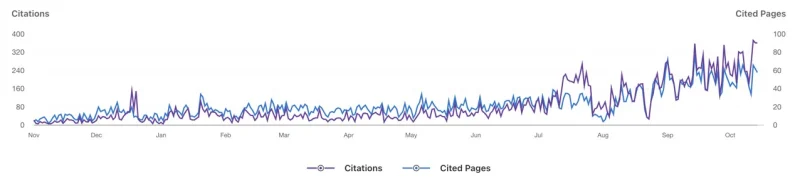
The author himself urges caution in assessing the size of the effect: the baseline was small, and the relationship between the publications and citations remains correlational. He also cites HubSpot’s observation that visitors from AI answers converted at roughly three times the rate of visitors from traditional search. These figures do not prove that publishing transcripts alone will produce the same result.
Three reasons B2B podcasts fail
Launching without an audience. If a company starts recording interviews without first planning how to attract listeners through other shows and guests, its episodes may go unnoticed.
Judging success by downloads alone. Download counts can include bot requests and repeat downloads, and they do not show who actually listened to an episode. The author suggests also tracking which companies are in the audience, which guests became potential customers, and whether buyers mention the show when they reach out. The ability to identify listeners’ companies depends on the platform’s tools, however.
No follow-up after recording. If a company stops communicating with a guest after the episode is published, the interview may not turn into a business opportunity. In the case cited, the author attributes the guest-to-customer conversion rate to the team’s follow-up work, not to the recording alone.
Where to start when measuring results
A podcast can simultaneously help a company find an audience, earn listeners’ time and attention, build relationships with guests, and create material for future publications. But it is a slow channel that requires careful coordination, and it is easy to launch one without a plan for distribution and guest follow-up.
HubSpot developed its channels over several years with a large marketing team; many B2B companies do not have those resources. The author therefore suggests looking beyond download counts and focusing on buyers: how many of the people the company wants to reach appeared on or listened to the show.
Source: https://www.searchenginejournal.com/b2b-podcast-growth-channel-search-cant-replace/596484/
Discussion
Sign in or create an account, to join the discussion.