Google Zero: Why a decline in search traffic does not mean its disappearance

7 views
Google Zero: Why a decline in search traffic does not mean its disappearance

The Google Zero concept suggests that referrals from Google Search and Discover will decline and eventually become insignificant for publishers. The author of the original article considers this prediction mistaken: although attracting visits from Google has become more difficult, the available estimates do not justify abandoning search engine optimization.

How Google search results have changed

Google began actively adding new elements to its search results in 2007. Instead of the familiar list of ten links, users gradually began receiving more information directly on the results page. Some clicks went to Google’s own services, including YouTube, Google Maps and image search, while some queries stopped sending users to websites altogether.

These changes affected many websites and led to legal proceedings, some of which, according to the author, are still ongoing. News publishers, however, did not experience the same level of pressure for a long time: the introduction of news carousels actually increased the flow of visitors to them. The issue drew renewed attention after the launch of AI Overviews.

The author credits The Verge editor Nilay Patel with introducing the term Google Zero, while noting that he may have drawn inspiration from the concept of Zero-Click Marketing, previously discussed by Amanda Natividad and Rand Fishkin of SparkToro.

What The Verge example shows

According to Similarweb data cited in the original article, The Verge’s traffic from Google began a sustained decline in late 2023, before the launch of AI Overviews. Google nevertheless remained the publication’s largest source of organic referrals; only direct visits were higher, and those were also declining.
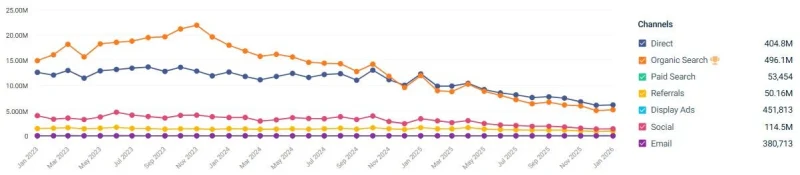
Иллюстрация из первоисточника

The author notes that the periods of most pronounced decline coincided with major Google search algorithm updates and penalties for site reputation abuse. He also points to a drop in The Verge’s traffic from other channels and suggests that the publication’s problems cannot be attributed solely to Google. The timing of the updates alone does not establish the cause of the decline.

Why estimates of the decline differ

The article compares Chartbeat data presented on the Reuters Institute website in its forecasts for 2026 with other sources. A Chartbeat chart showed a significant decline in Google traffic for many of the service’s clients.

The author says he has access to Google Search Console data for dozens of European sites belonging to one of his clients. According to him, this publisher did not lose Google traffic, and many of its sites saw growth. This observation applies to a specific group of sites and does not rule out losses among other publishers.

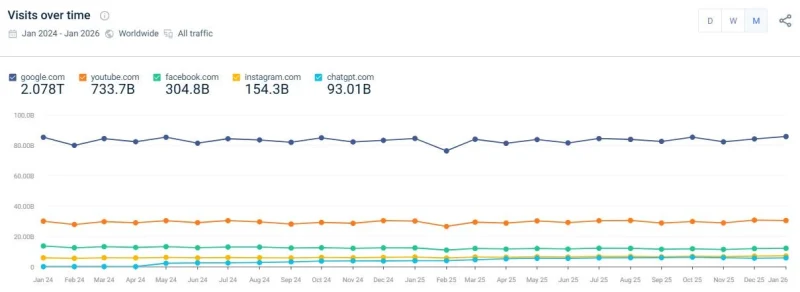
The article also cites a Press Gazette review based on conversations with UK publishers, who generally did not report such a substantial drop in Google traffic. In addition, Similarweb data published by Graphite indicated a 2.5% decline in Google traffic to the largest websites worldwide.

The author hypothesizes that Chartbeat’s aggregate figures may have been heavily affected by losses at a few major clients, including losses following algorithm updates or penalties. This is a proposed explanation for the discrepancy, not an established cause. According to a Similarweb estimate he also cites, Google accounted for nearly 20% of all website visits worldwide, and that share had not changed significantly over the preceding few years.

Diversification without abandoning SEO

The author supports seeking alternative sources of audience traffic: publishers can benefit from reducing their dependence on Google and developing channels that support their business model. However, he believes it would be a mistake to do so at the expense of investment in SEO. In his view, Google remains the largest individual source of website referrals, and there is no comparable replacement.

The article notes that direct traffic should not be considered a single channel: this category includes visits for which referral source information was not passed on.

In the author’s view, the main strategic risk is a self-fulfilling prophecy. If a publisher cuts back on SEO, it may lose some search traffic, take that as confirmation of Google Zero and reduce investment even further. Meanwhile, competitors that continue working on search may gain the referrals it has left behind. The author’s conclusion is not that growth through Google is easy, but that the increasing difficulty of this work is not a reason to abandon it.

The source material was originally published on SEO For Google News.
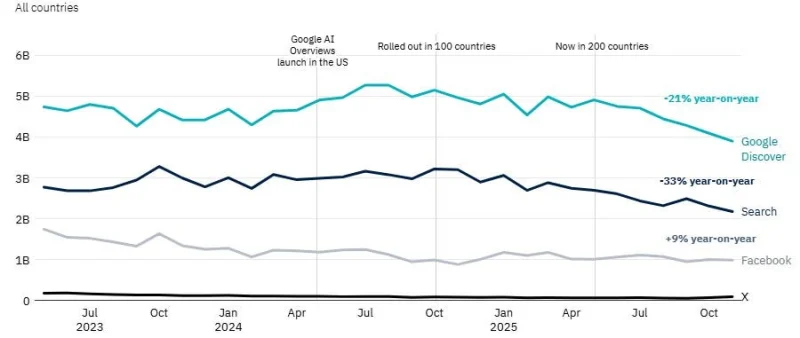
Иллюстрация из первоисточника

Source: https://www.searchenginejournal.com/google-zero-is-a-lie/568668/

Discussion

Sign in or create an account, to join the discussion.

JOIN THE ULTRAS

A Telegram channel with exclusive case studies you won't find on the site and the most hard-hitting market insights.

SUBSCRIBE ON TELEGRAM

Traffic arbitrage made simple — articles, news and case studies


Imagine earning money online simply by directing traffic and getting paid for every successful conversion. No product of your own, no office, no bosses. Sounds like a fairy tale? In fact, it’s traffic arbitrage, and for many, it has already become a steady source of income, bringing in hundreds to thousands of dollars a day. But in this field, knowledge is just as important as practice. Where can you find setups that work? How do you avoid wasting your budget? Where can you learn strategies from the pros?

There’s one answer: read traffic arbitrage articles on Traffic Ultras, a niche media outlet. Here, you can make sense of trends, find proven case studies and learn from mistakes. You’ll also find everything you need to know to get started if you’re just entering the world of traffic arbitrage.

CPA arbitrage – articles everyone should read


Today, CPA arbitrage articles are more than just content: they’re comprehensive guides that can replace courses and consultations. They’re written by active media buyers, tested in practice and cover the full range of arbitrage work: from setting up trackers and collecting analytics to scaling setups and launching large teams.

These articles are packed with practical advice:

  • how to prepare a setup around a news event,
  • how to analyze results and optimize creatives,
  • how to choose the right offer without wasting your budget,
  • which details to pay attention to.

You can also find unique case studies involving Facebook, Google, TikTok, UAC and even native advertising.

Important: if you want to understand how to start earning from traffic arbitrage, start by reading these resources. Our site has a convenient structure and internal links. For example, after reading about launching a campaign on TikTok, you can go to an article on warming up accounts or visit the traffic arbitrage forum to ask questions directly.

A traffic arbitrage blog by practitioners

What makes a traffic arbitrage blog truly valuable? It’s not theory, but hands-on experience, real traffic and concrete numbers. There’s no fluff here — just proven methods and up-to-date approaches. This kind of content lets you do more than read: you can apply what you learn to your own work. It’s especially useful if you’re already taking your first steps but don’t know how to get the most out of Facebook or properly test push and pop networks.

A modern traffic arbitrage blog is more than just articles; it’s a complete media ecosystem. Traffic Ultras tracks gambling news, trends across verticals and new approaches to creatives, helping our readers stay up to date on the latest strategies.

You can also find partners, frameworks, scripts and even a team through a traffic arbitrage blog. Collaborations emerge in comments and chats, while media buyers share ideas and experience.

Traffic arbitrage – a blog for beginners

If you’re just starting out, a beginner-friendly traffic arbitrage blog is the best way to enter the industry. This kind of content is easy to follow without sacrificing usefulness, covering everything from terminology to launching your first campaign.

A traffic arbitrage blog helps you avoid classic mistakes: wasting your budget on poor pre-landers, ineffective bridge pages and offers that don’t get approved. It explains the mistakes beginners make, how to communicate with CPA network managers and how to avoid getting banned on Facebook with your first campaign. It’s all based on the authors’ real-world experience.

You’ll also find step-by-step instructions, useful checklists and sometimes free templates and trackers. This makes traffic arbitrage blogs especially useful both when you’re starting out and as you grow. They also regularly publish news to help readers keep up with their vertical.

A good traffic arbitrage blog is a guide to the world of traffic that shows: anyone can earn money by taking a systematic, consistent approach.

Questions and Answers

How do you start earning from traffic arbitrage? Articles and blogs to help beginners

If you don't know where to start, check out the CPA arbitrage articles on our site, which explain the basics of arbitrage and how to work with offers and traffic sources in detail. A traffic arbitrage blog can also be a great resource, with experienced media buyers sharing case studies and tips that even beginners can understand.

Which traffic sources are most effective in 2025, according to arbitrage blogs?

An analysis of leading traffic arbitrage blogs reveals several key sources in 2025: TikTok Ads, push traffic, Telegram Ads, and YouTube Shorts. Formats that generate engagement quickly are particularly effective, and traffic arbitrage articles are increasingly focusing on these channels.

Which verticals generate the most revenue, according to traffic arbitrage blogs?

According to authors of popular traffic arbitrage blogs, the most profitable verticals in 2025 are gambling, Nutra, dating, and crypto. An arbitrage blog helps beginners quickly learn the ins and outs of each vertical, including rules for creatives and approaches.

Which arbitrage blog publishes real case studies?

The most valuable resources present each case study as a step-by-step story, from testing to ROI. That's how the Traffic Ultras arbitrage blogs are created: by practitioners who share not only their successes but also their failures, helping readers learn from others' experiences.