
FAQ optimization, structured data and conversational query targeting can help improve visibility in AI search. But on their own, they don’t answer the central strategic question: what business problem is the company trying to solve? A sustainable AI SEO strategy starts with that problem, builds on the brand’s strengths and only then moves on to specific actions.
Start with the business problem, not the platform
Wanting to appear in ChatGPT answers or earn more citations does not in itself define a strategic goal. First, you need to understand whether AI search affects brand awareness, lead generation, category position or buyers’ decisions.
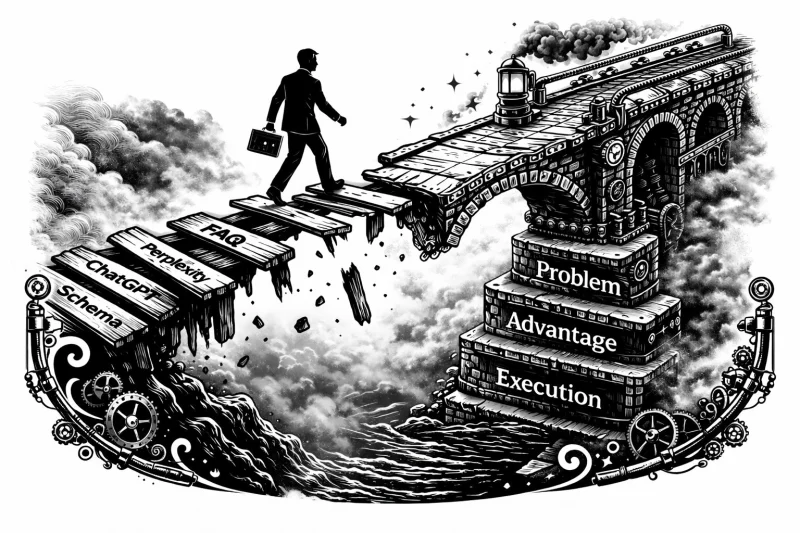
For example, a brand may lose visibility when AI answers queries related to it without citing a source. Another problem is a company’s absence from answers to queries important for customer acquisition, or situations where models name competitors as the solution to a problem. Some product research may also take place in an AI interface before a user visits the website—or without a visit at all—and conventional analytics won’t reveal the details of that audience’s behavior.
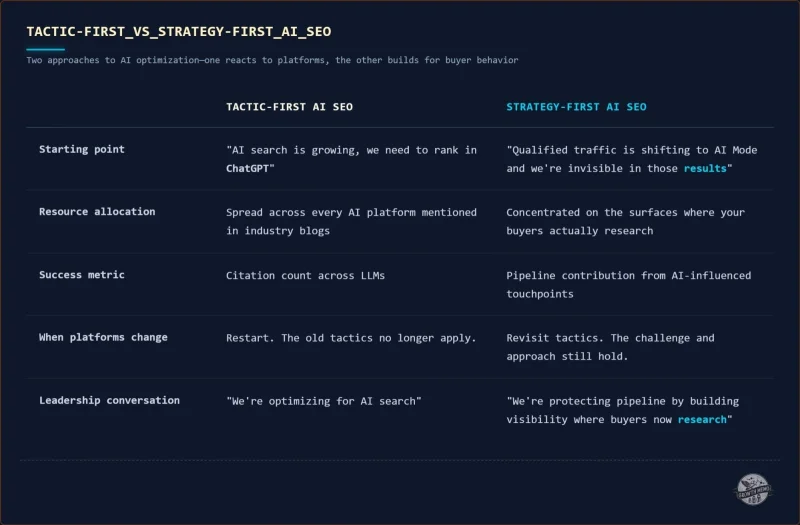
The problem statement should be tied to revenue, market share or competitive position. Otherwise, the team risks improving a metric that is hard to defend in budget discussions.
Test assumptions through research
Audience behavior and the mechanics of visibility vary by industry, query and user intent. So before choosing tactics, the author recommends finding out where customers use AI search. This can be done by surveying buyers, examining referral data and reviewing user session recordings. The AI Mode behavior study mentioned examined 250 sessions.
Next, compile a set of queries associated not just with visits, but with the potential for a purchase. You can start with the questions and problems the sales team hears from customers: turn them into possible ChatGPT or Google queries and check whether the brand appears in AI answers.
For these queries, examine both your own pages and third-party mentions—for example, on Reddit or G2. The author suggests checking which content formats and external platforms receive citations in a particular category. According to the analysis “The Science Of How AI Pays Attention,” 44% of citations came from the first 30% of a page. As an experiment, the author suggests rewriting the first three paragraphs of the ten most important pages, placing the answer, claims and data before the context. That figure alone does not guarantee that such an edit will increase citations.
Establish a baseline for brand and competitor visibility using tools such as AirOps, Profound or SearchGPT, then identify the gap between that baseline and the desired position. To find the causes, the author suggests the “five whys” method: a lack of citations may be related to content depth, authority signals or technical accessibility, and each problem calls for a different solution.
Build a strategy in three parts
The problem. State the core business problem in one sentence. For example: the brand is absent from AI answers to category-defining queries, so competitors gain buyers’ attention early in the decision-making process.
The approach. Describe how the company plans to solve the problem using what it does better than competitors or what is uniquely available to it. This could mean building authority through expert publications, executive appearances on podcasts and original research; creating content based on unique product data; or working with customer stories and user-generated content. Personas built on real customer data can help identify community signals that align with buyers’ search behavior.
The actions. Only after choosing an approach should you list tactics: creating or updating content for specific conversational queries, ensuring language model crawlers can access your site, using digital PR to earn third-party mentions, creating content for specific personas and using internal links as an entity map. The author also suggests synthetic personas for scaling prompt tracking.
The document should specify what share of resources will go to each area and link success metrics to business outcomes, rather than limiting measurement to citation counts.
Discuss investment through scenarios
The author advises against presenting a traffic forecast for the emerging field of AI search as a reliable estimate. Instead, you can present leadership with conservative, moderate and aggressive scenarios, including the resources required, possible outcomes and checkpoints at which the team will decide whether to continue investing.
As an illustration, a scenario might allocate 30% of resources to building authority and 20% to conversational content, with an expected 40–60% increase in citations over six months and an influence on 15–20% of associated conversions based on attribution data. This is an example for discussion, not a validated forecast or a universal result.
Reversible decisions make the proposal easier to understand: the problem statement sets the goal, the approach describes the strategic bet, and interim reviews allow the team to adjust or stop the work.
Review the strategy every quarter
Platforms, user behavior and the results of your own experiments can change which actions make sense. At the quarterly review, ask what has changed in AI search, what the tests have taught you, whether the tactics support the chosen approach and whether the approach still addresses a relevant problem.
The strategy should remain a decision-making tool, not a fixed task list. Its foundation is the business problem and the brand’s strengths; specific tactics can be changed as needed.
Which research and resources can help with implementation
For audience research, the author recommends Growth Memo resources on creating personas from internal data, using them across content, product and SEO teams, and using synthetic personas to track prompts. The last resource claims 85% accuracy in modeling the search behavior of audience segments.
For studying user behavior, the author mentions a Google AI Overviews UX study involving 70 people who completed eight tasks, and a study of 250 AI Mode sessions. A follow-up to the latter examines what can be measured about AI Mode’s impact on SEO and what remains an assumption.
Other resources in the library cover the topical approach to SEO, measuring topical and brand authority, pruning weak pages, internal links and the impact of backlinks on AI visibility. The analysis “The Science Of How AI Pays Attention” is based on 1.2 million search results; a separate analysis of backlinks and AI visibility covered 35,000 data points.
Source: https://www.searchenginejournal.com/how-to-build-an-ai-seo-strategy-that-outlasts-tactics/568661/
Discussion
Sign in or create an account, to join the discussion.