Sites are blocking AI training bots: could this hurt brand visibility?

10 views
Sites are blocking AI training bots: could this hurt brand visibility?

Companies are increasingly restricting access for bots that collect data to train language models, while allowing AI assistant search bots to access their sites. That is the finding of a Hostinger analysis based on data from 2025. For businesses, this creates a difficult choice between protecting content and appearing in AI-generated answers.

What Hostinger found

The hosting provider and online business platform analyzed anonymized website logs covering 66.7 billion bot interactions with 5 million sites. Data was collected over three six-day periods in June, August and November 2025.

During that period, OpenAI SearchBot’s reach grew from 52% to 68% of sites, while Applebot, which indexes content for Apple’s search features, increased from 17% to 34%. The reach of traditional search engine bots remained almost unchanged. This may indicate that AI assistants are becoming an additional channel for accessing information rather than replacing search engines entirely.

At the same time, the reach of GPTBot, which OpenAI uses to collect training data, fell from 84% of sites in August to 12% in November. Meta ExternalAgent’s reach dropped from 60% to 41%. Possible reasons for the restrictions include a desire to control data use and concerns about copyright.

Model training and assistant responses are different tasks

During training, a language model learns information that is then reflected in its parameters, or weights. This is called parametric knowledge. It can include information about people, objects and companies, but it does not work like a simple reference book with a separate entry for each fact.

Blocking a training bot prevents it from collecting material directly from a site for training. However, this does not necessarily mean the model will learn nothing about the company: information can come from other sources. Moreover, access to a site does not in itself guarantee that its content will be incorporated into the model or accurately reproduced in an answer.

AI assistant search bots perform a different task: they help find material for answers. Allowing some bots while blocking others may therefore reflect a company’s intention to appear in search results and assistant responses without providing its content for model training.

Why site owners restrict access

In a Reddit discussion, one site owner asked how to maintain indexing in Google Search without allowing Gemini, ChatGPT and other systems to collect and use the content. The author later explained that they publish unique material in a narrow niche and want to receive search traffic without handing that information over to language models.
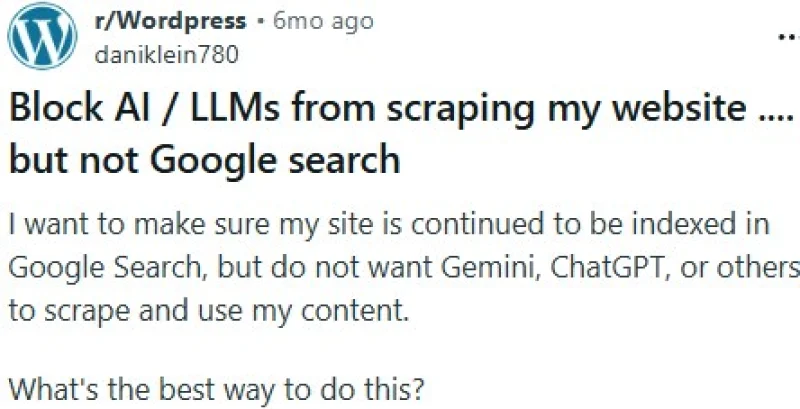
Иллюстрация из первоисточника

For a site offering unique instructions, this approach may be justified: if an assistant answers a question without sending the user to the site, the visitor has less reason to open the original source. But for a review and comparison site or an online store, the balance may be different: restricting access can also reduce opportunities to provide models with information about the company and its offerings.

What this means for brand representation

When a user receives an answer within an AI interface, they may not visit the company’s site. This can potentially reduce direct traffic and limit the company’s ability to present prices, product context and brand positioning. By blocking training bots, companies may become more dependent on search indexes and third-party sources; whether that is enough to represent a business accurately remains an open question.

According to Hostinger’s Head of AI, Tomas Rasimas, as businesses shift from a click-based model to interactions through assistants, the risk is not just about AI access itself, but also about losing control over how price, positioning and the value of an offering are presented at the moment a decision is made.

Changes to the customer journey can also make ad attribution and revenue forecasting more difficult: a purchase made after an assistant’s answer does not necessarily look like a direct visit to the site. However, Hostinger’s analysis measured bot reach, not the effect of specific access settings on sales or answer accuracy.

How to approach the decision

There is no universal answer for every site. Owners should weigh the value of protecting unique content against the potential benefit of having company information present in AI systems, considering training and search bots separately. It is also important to distinguish confirmed consequences of restrictions from potential risks.

Source: https://www.searchenginejournal.com/more-sites-blocking-llm-crawling-could-that-backfire-on-geo/565614/

Discussion

Sign in or create an account, to join the discussion.

JOIN THE ULTRAS

A Telegram channel with exclusive case studies you won't find on the site and the most hard-hitting market insights.

SUBSCRIBE ON TELEGRAM

Traffic arbitrage made simple — articles, news and case studies


Imagine earning money online simply by directing traffic and getting paid for every successful conversion. No product of your own, no office, no bosses. Sounds like a fairy tale? In fact, it’s traffic arbitrage, and for many, it has already become a steady source of income, bringing in hundreds to thousands of dollars a day. But in this field, knowledge is just as important as practice. Where can you find setups that work? How do you avoid wasting your budget? Where can you learn strategies from the pros?

There’s one answer: read traffic arbitrage articles on Traffic Ultras, a niche media outlet. Here, you can make sense of trends, find proven case studies and learn from mistakes. You’ll also find everything you need to know to get started if you’re just entering the world of traffic arbitrage.

CPA arbitrage – articles everyone should read


Today, CPA arbitrage articles are more than just content: they’re comprehensive guides that can replace courses and consultations. They’re written by active media buyers, tested in practice and cover the full range of arbitrage work: from setting up trackers and collecting analytics to scaling setups and launching large teams.

These articles are packed with practical advice:

  • how to prepare a setup around a news event,
  • how to analyze results and optimize creatives,
  • how to choose the right offer without wasting your budget,
  • which details to pay attention to.

You can also find unique case studies involving Facebook, Google, TikTok, UAC and even native advertising.

Important: if you want to understand how to start earning from traffic arbitrage, start by reading these resources. Our site has a convenient structure and internal links. For example, after reading about launching a campaign on TikTok, you can go to an article on warming up accounts or visit the traffic arbitrage forum to ask questions directly.

A traffic arbitrage blog by practitioners

What makes a traffic arbitrage blog truly valuable? It’s not theory, but hands-on experience, real traffic and concrete numbers. There’s no fluff here — just proven methods and up-to-date approaches. This kind of content lets you do more than read: you can apply what you learn to your own work. It’s especially useful if you’re already taking your first steps but don’t know how to get the most out of Facebook or properly test push and pop networks.

A modern traffic arbitrage blog is more than just articles; it’s a complete media ecosystem. Traffic Ultras tracks gambling news, trends across verticals and new approaches to creatives, helping our readers stay up to date on the latest strategies.

You can also find partners, frameworks, scripts and even a team through a traffic arbitrage blog. Collaborations emerge in comments and chats, while media buyers share ideas and experience.

Traffic arbitrage – a blog for beginners

If you’re just starting out, a beginner-friendly traffic arbitrage blog is the best way to enter the industry. This kind of content is easy to follow without sacrificing usefulness, covering everything from terminology to launching your first campaign.

A traffic arbitrage blog helps you avoid classic mistakes: wasting your budget on poor pre-landers, ineffective bridge pages and offers that don’t get approved. It explains the mistakes beginners make, how to communicate with CPA network managers and how to avoid getting banned on Facebook with your first campaign. It’s all based on the authors’ real-world experience.

You’ll also find step-by-step instructions, useful checklists and sometimes free templates and trackers. This makes traffic arbitrage blogs especially useful both when you’re starting out and as you grow. They also regularly publish news to help readers keep up with their vertical.

A good traffic arbitrage blog is a guide to the world of traffic that shows: anyone can earn money by taking a systematic, consistent approach.

Questions and Answers

How do you start earning from traffic arbitrage? Articles and blogs to help beginners

If you don't know where to start, check out the CPA arbitrage articles on our site, which explain the basics of arbitrage and how to work with offers and traffic sources in detail. A traffic arbitrage blog can also be a great resource, with experienced media buyers sharing case studies and tips that even beginners can understand.

Which traffic sources are most effective in 2025, according to arbitrage blogs?

An analysis of leading traffic arbitrage blogs reveals several key sources in 2025: TikTok Ads, push traffic, Telegram Ads, and YouTube Shorts. Formats that generate engagement quickly are particularly effective, and traffic arbitrage articles are increasingly focusing on these channels.

Which verticals generate the most revenue, according to traffic arbitrage blogs?

According to authors of popular traffic arbitrage blogs, the most profitable verticals in 2025 are gambling, Nutra, dating, and crypto. An arbitrage blog helps beginners quickly learn the ins and outs of each vertical, including rules for creatives and approaches.

Which arbitrage blog publishes real case studies?

The most valuable resources present each case study as a step-by-step story, from testing to ROI. That's how the Traffic Ultras arbitrage blogs are created: by practitioners who share not only their successes but also their failures, helping readers learn from others' experiences.